

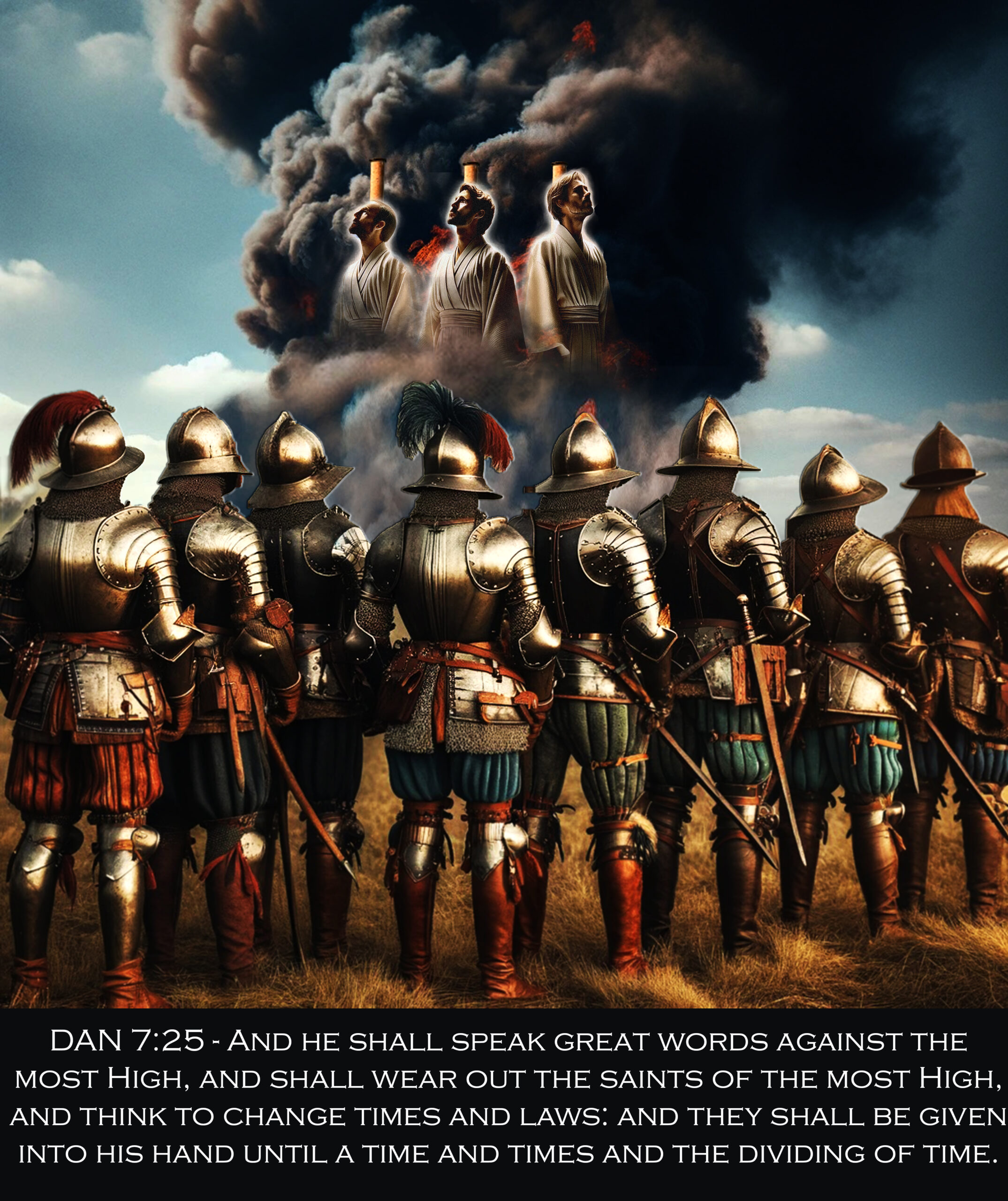
Daniel Unlocked #44. 16th Century Protestant Reformers Identify the Little Horn.
In the 16t Century Martin Luther boldly asserted, “We firmly believe that the Papacy is the true seat of the antichrist.” John Calvin echoed this sentiment, declaring, “I reject him as the vicar of Christ… He is the antichrist—I deny him as the head of the church.” John Knox concurred, stating, “The tyranny exercised by the pope over the church for centuries is the very antichrist and son of perdition referred to by Paul.” John Wesley concluded emphatically, “The Roman Papacy is, in a specific sense, the man of sin.”
These reformers did not arrive at such conclusions to demean the Roman Catholic Church; rather, their assertions were the result of meticulous scrutiny of Scripture. Their writings reveal a compelling and earnest engagement with the evidence, compelling them to identify the Roman Catholic Church as the sole entity meeting the specified criteria.
Protestants who discern the Papacy as the beast or little horn harbor a profound concern for the well-being of their Roman Catholic brethren. They acknowledge the sincerity of many Roman Catholics in their faith but perceive them as deceived. Considering Christ’s plea in Revelation 18:4 –
“Come out of her, my people, that you may not partake in her sins, and that you may not receive of her plagues”
– it becomes imperative to make this identification. Although it is disheartening to label such a widespread religion, true Christian love necessitates a sincere and urgent call based on the clarity of Scripture.
The Roman Catholic Church’s role in the paganization of Christianity unfolded rapidly from the fourth century onwards. The turning point was the purported conversion of Roman Emperor Constantine in 321 A.D., which prompted an influx of European pagans into Christianity. However, many retained their pagan practices, masking them with Christian terminology and renaming their idols statues with Christian names. The introduction of idol worship, the pagan baptismal practice, and the confession of sins to priests diluted the pure biblical teachings. Even Easter, ostensibly a Christian celebration, bore pagan roots, being named after the fertility goddess Eostre, complete with ancient fertility symbols like eggs and rabbits.
As part of the pagan celebrations of Ēostre, buns, marked with a cross, would be baked across pre-Christian Europe to celebrate the springtime goddess. The symbolism of the cross on the bun was said to represent the four seasons as well as the four primary phases of the moon. The 25th of December is the winter solstice for the northern hemisphere and refers to the rebirth of the sun – adapted to be the birth of the Son. The Bible does actually give us a date for the birth of Jesus. Luke clearly puts the birth of Christ in September, during the feast of Tabernacles, which fulfills the typology.
Moreover, the belief in the immortality of the soul, borrowed from paganism, contradicts the clear scriptural assertion that “God alone has immortality.”(1 Timmothy 6:15-16). This led to the misconception that virtuous individuals ascend to heaven at death, while the wicked face eternal torment. Christ’s teachings, however, emphasize our union with Him upon His return, not at death. (see e.g.John 14:1-3).The notion of an eternal, conscious torment finds no support in the Bible. (see e.g. 2 Thessalonians 1:9, which speaks of the “everlasting destruction.” of the unsaved.)
The infusion of pagan concepts also distorted the biblical doctrine of justification by faith alone, replacing it with a works-based system. The Bible also knows nothing of the pagan concept of purgatory. “God saved you by his grace when you believed. And you can’t take credit for this; it is a gift from God. Salvation is not a reward for the good things we have done, so none of us can boast about it. For we are God’s masterpiece. He has created us anew in Christ Jesus, so we can do the good things he planned for us long ago. (Ephesians 2:8-10NLT).
Furthermore, the Sabbath—the commandment embodying the gospel message of resting in a finished work (Justification by faith) — was replaced with Sunday, aligning with the day of the sun, sanitized as a memorial of Christ’s resurrection (without any biblical support). If paganism tainted the fringes of Christianity, it has also undeniably penetrated its core, altering fundamental doctrines and practices.
Happy Sabbath pastor Ross i can’t thank you enough for this study