

Daniel Unlocked #37. The Little Horn from the Fourth Beast.
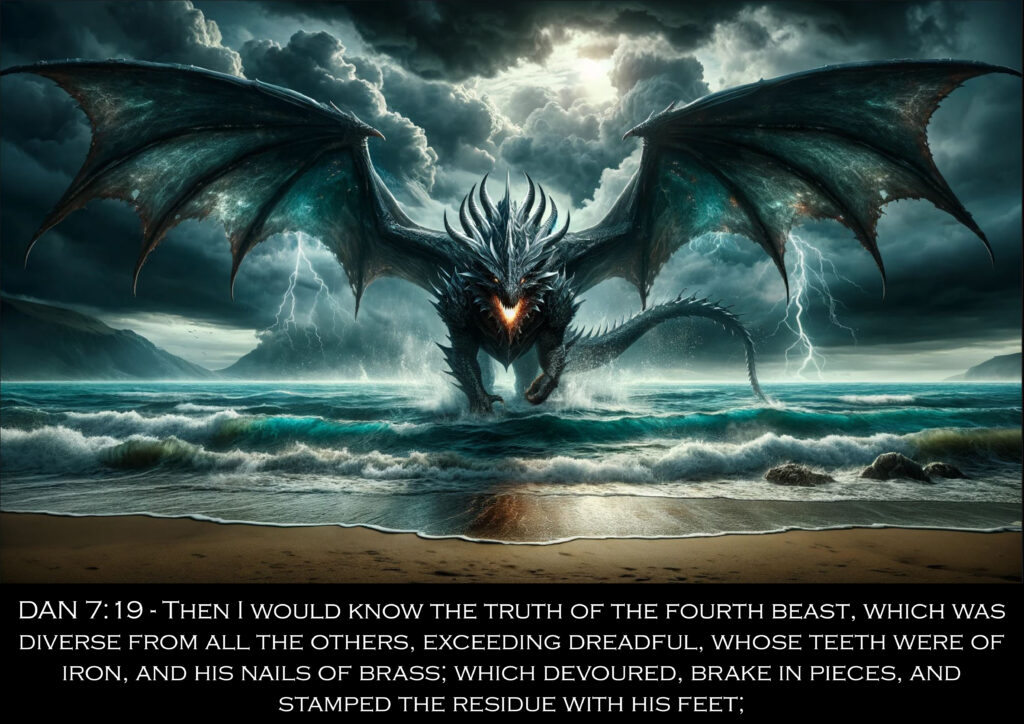
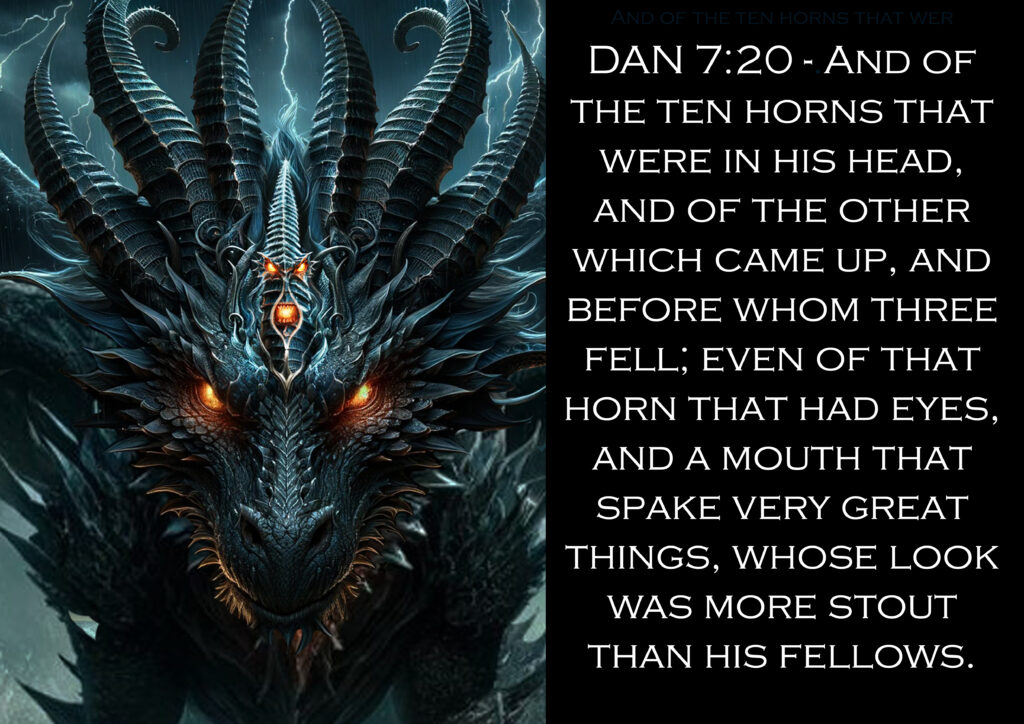
Yesterday we learned that the ferocious animal with ten horns ruling the world with utmost cruelty represents pagan Rome. Now we must consider the little horn and the power it represents. As portrayed in the vision, the fourth animal has ten horns, of which three horns were plucked out to make way for the ‘little horn.’ This horn has human eyes and speaks “pompous words” (Dan. 7:8). It is clear that the little horn emerges from the entity represented by the terrible animal, which is pagan Rome. In a way, the horn extends or continues some features of pagan Rome. It is just a later stage of the same power and still carries the name Roman.
Daniel sees this other horn making war against God’s people (the saints.) The angel explains to him that this horn is a king who will perform three unlawful actions: (1) It will speak pompous words against the Most High, (2) It will persecute the saints (God’s people) of the Most High, and (3) it will intend to change times and law. Consequently, the saints would be given into his hand. Saints, according to the Bible are anyone who believes in Jesus. Paul often addressed his letters to e.g. “The saints who are faithful in Christ Jesus.” (Eph.1:1). The English word saint comes from the Latin sanctus, with the Greek equivalent being hagios – ‘holy’. The word hagios appears 229 times in the Greek New Testament. A “holy one,” is someone who is set apart for God’s special purposes. As a result, every follower of Jesus Christ is a saint.
The unbiblical idea of a saint developed during the Middle Ages in the mind of the established church.
Next, the angel gives the time frame for the activities of the little horn: a time, times and half a time. To understand this expression refer back to Daniel 4 verse 16 and 32 where “seven times would pass over him (Nebuchadnezzar) represent the 7 years of his madness. In this instance of prophetic language, the word time means “year,” and so the expression times signifies years, a dual form: “two years.” Hence, this is a period of three and a half prophetic years, which, according to the year-day principle, indicates a period of 1,260 days or prophetic years. During this 1260 years the little horn will mount an attack against God, persecute God’s people (the saints,) and attempt to change God’s law.
Read 2 Thessalonians 2:1–12 and note the similarities between the man of lawlessness and the little horn? What is the only power that arose out of pagan Rome but remains part of Rome and still carries its name, a power that extends from the time of pagan Rome until the end of the world, meaning that it still exists today?
In Summary, there are nine ways in this chapter to identify the Little Horn. (1) The location of its rise in Western Europe. (2) The time of its rise would be after the collapse of Rome in 476 and it would come from the divisions of Europe. (3) The manner of it rise – it would subdue 3 of the divisions of Rome that opposed its rise to power. (4) The nature of its power because it would be ‘different’ – a religious and political power. (5) The extent of its power. It would be ‘stout’ and speak ‘great things’, that is, it would be more important and rule over the others. (6) It’s character. It would be ‘boastful’ (7) The work of its power. It would make war on God’s people. (8) The sign of its power – it would change the ‘times and the laws.’ (9) The time frame of its power – 1260 years.
The church succumbed to the temptation that the devil thrust at Jesus in the wilderness when he showed Jesus all the kingdoms of the world and said, “I will give it all to you if you will kneel down and worship me.” (Matt 4:8-10 NLT)
There is only one power, that is both religious and political, that could possibly fulfill all the criteria described in this chapter. Revelation 13 will make this even more evident. Daniel 7:22 reveals that this power will exist until the second coming. Between Daniel and Revelation we will see that this power will morph between various stages of its existence, the last being worse than its former medieval equivalent.